
The activity of this laboratory focuses on the development of tools, visualization environments, and applications based on Virtual Reality (VR), Augmented Reality (AR), and Mixed Reality (MR), as well as tracking and natural interaction systems, computer vision techniques, and data visualization and analysis applied to solving technological challenges and problems.
The main areas of application include security and surveillance; automation and personalized assistance in intelligent environments; surgery and legal and forensic medicine; architecture and urban planning; and the visualization and analysis of large-scale data sets to support large-scale decision-making (for example, in Smart Cities).
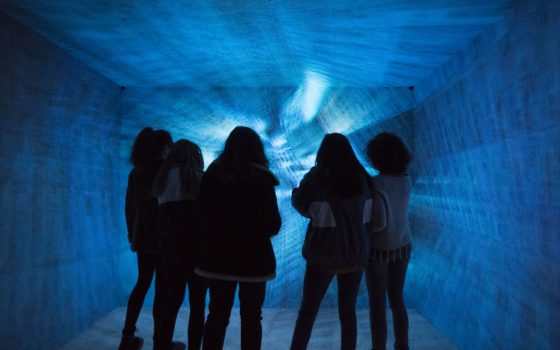
The main infrastructure of CeDInt’s Virtual and Augmented Reality Laboratory is a stereoscopic projection system of the CAVE™ (Cave Automatic Virtual Environment) type. This is an immersive 3D visualization system in which the sense of immersion is achieved using Active Infitec®+ stereo projection technology onto five large screens arranged to simulate a cube in which the user stands. In addition, the laboratory features an advanced rear-projection system (3D PowerWall) with capacity for 30 people, as well as a portable virtual reality system consisting of a rear-projection screen and two DLP projectors.
- Virtual Reality
- Augmented Reality
- Computer Vision
- Visual Information Analysis
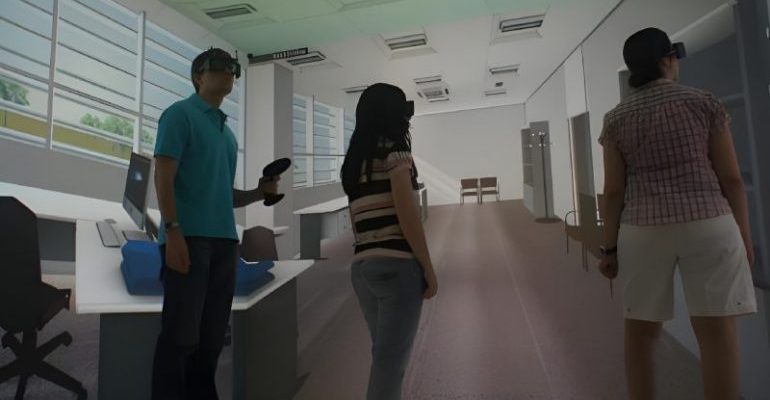
The term Virtual Reality (VR) refers to any computer-generated environment capable of simulating real-world physical settings as well as imaginary worlds. The level of presence within a virtual environment depends on how immersed our senses are. To achieve this, VR uses real-time stereoscopic graphics through different visualization technologies (Head Mounted Displays or HMDs, large-scale displays such as StereoWall systems, multi-screen environments like CAVE™ systems, etc.), tracking systems to monitor one or more users, and haptic sensory devices.
At the CeDInt Virtual Reality Laboratory, our work is mainly focused on the creation of realistic 3D content and applications that enhance the user’s sense of immersion in the presented content. We view virtual reality not only as a key technology for visualization and experience simulation, but also as a powerful tool for solving real-world problems. With this approach, our projects aim to identify and address such challenges—for example, the development of a facial soft-tissue reconstruction tool or a controlled-environment monitoring system to support decision-making.
The main fields of application include: Design, modeling, and visualization of objects and places of interest such as buildings, environments, industrial products, and prototypes. Reconstruction and virtual tours of real historical sites and cultural heritage. Visualization of complex data and process simulation. Collaborative training and education to prepare individuals for complex and/or hazardous situations. Scientific research in medicine through the virtual reproduction of real-life conditions and the study of user behavior in controlled and practical environments.
The goal of Augmented Reality (AR) is to integrate digital content into the image perceived by users in real time. It literally means adding relevant information to the surrounding environment. Unlike Virtual Reality, AR does not simulate a real scene. Instead, it uses the real world as a base and overlays contextual information to enhance the user’s understanding of their environment. One of the most common examples—and one of the earliest commercial AR applications—was the insertion of the offside line in televised football matches. At CeDInt, we develop augmented reality projects that display content on mobile devices (e.g., tablets and smartphones), aiming to create experiences in which users perceive enriched information about their surroundings. This technique provides a development framework for research and innovation across a wide range of areas, including entertainment, military training, engineering design, robotics, manufacturing, and other industries.
The main fields of application of AR include: User localization in unknown environments using robotics-based algorithms such as SLAM and PTAM. Overlaying contextual information onto the geometry of the environment. Reconstruction of ruins, buildings, or landscapes that previously existed. Provision of interactive content to support learning processes. Decision-making support in industrial prototyping or process visualization before project completion. Assistance in complex assembly, maintenance, or surgical tasks. Visualization of construction projects prior to their completion.
Computer Vision, also known as Machine Vision, is a branch of Artificial Intelligence that encompasses the set of techniques enabling a machine to recognize the structure and properties of images in a way similar to human perception. To achieve this, Computer Vision relies on methods such as image processing, pattern recognition, statistical learning, and graph theory. At the CeDInt Virtual Reality Laboratory, Computer Vision techniques are used to support the areas of Virtual Reality and Augmented Reality. These techniques process images captured by cameras and provide the necessary data to end applications—for example, detecting a specific object or estimating scene depth in order to enable interaction. Among the Computer Vision techniques we commonly work with are: Segmentation; Feature extraction; Stereo matching; Facial recognition; Scene reconstruction.
Problem solving, both in academic and business environments, is closely linked to how data are analyzed. In the era of data explosion, this can become truly critical if researchers lack appropriate tools and methodologies to facilitate understanding. For this reason, information visualization and visual analytics have become highly active research areas in recent years. The former aims to visually represent abstract information in a way that is more easily understandable to humans; the latter enhances human reasoning and understanding of complex and dynamic scenarios through perceptual mechanisms.
The ultimate goal of both is the acquisition and extraction of knowledge from raw data through interactive visual metaphors. Currently, CeDInt’s projects in this field address the following topics: Geospatial data representation; Temporal (timeline-based) data analysis; Understanding complex patterns in urban areas; Advisory support for policymakers; Advisory support for data mining experts; Representation of data features in virtual and/or augmented reality environments.